An AI assistant for your sales team: what to prepare before the project starts
What has to be in place before deploying an AI assistant: an audit of data sources, a master system per data type, access approvals and quality criteria. With a readiness checklist.
Short answer: deploying an AI assistant in sales is 60–70% work on data, not on the model. If the company has no answer to “which system is the source of truth for prices”, the assistant will confidently produce wrong numbers, and trust in it will be gone within the first week.
Here is what is worth putting in order before a budget is signed.
Why the project does not start with the model
Choosing the model is the most discussed and least consequential decision in a project like this. Modern models, hosted and local alike, are good enough to answer coherently from your documents. The differences between them show up at the edges, not in everyday scenarios.
Something else breaks. The assistant answers from what it found in your store. If the store holds three versions of the price list with no indication of which is current, it will quote any of them. If a product is named differently in the CRM and in the accounting system, it will not connect the two. If a regulation was withdrawn six months ago but still sits in the same folder, the assistant will cite the withdrawn one.
None of that is fixed by changing the model. All of it is fixed before development starts, or not at all.
Five things that have to be ready
One: an inventory of sources. Not “it is all in our ERP”, but a list: where the price lists live, where the technical specifications are, where contract terms sit, where customer correspondence is, where the presentations are. There are usually more sources than the manager remembers.
Two: a master system per data type. For each entity — products, prices, customers, contracts, stock — there must be a single answer to “where is the truth”. Every other copy is either reconciled to the master or explicitly excluded from the index.
Three: access. Service accounts with read access to each system, approved by security. In practice this is the longest item: approval to read a mail archive or a contract database takes weeks, and it should start alongside discovery rather than after it.
Four: rules for what is current. How do you tell that a document is out of date? A date in the file name, a field in the system, an “archive” folder? If there is no formal marker, you will have to invent one, because otherwise there is nothing to filter on.
Five: a set of real questions. Twenty to thirty queries your sales people ask most often, with the correct answers. This is both the specification and the way to measure quality. Without it, “the assistant answers well” stays a matter of taste.
Auditing sources: who is master of what
The most common starting position in a mid-sized business is several systems accumulated over the years, where the same data lives in two or three places and disagrees with itself.
A typical example: after an acquisition there are two CRMs. One holds the current deals, the other the historical ones but with richer customer records. The right answer is not “index both” but to split them: customers come from the first, history from the second, and the assistant knows which field comes from where.
A separate category is data that is not in any system. A specific customer’s contract terms, verbal agreements, the reasons behind past rejections. That lives in the sales team’s heads, and the assistant will not replace them. The honest boundary of the project runs right here.
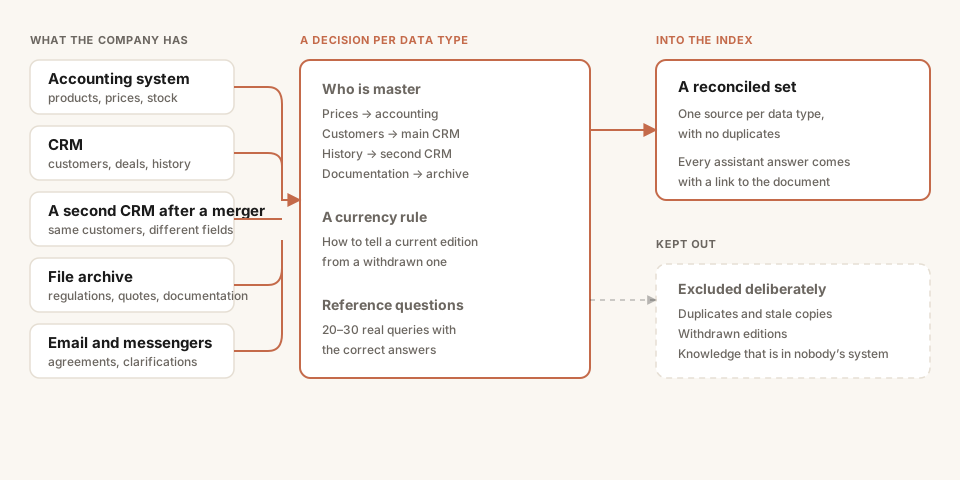
The point of the audit is not to collect everything but to decide what stays out of the index. Excluding a duplicate is cheaper than explaining contradictory answers later.
How to tell the data is not ready
A few signs that preparation has been underestimated:
- different people give different answers to “which system is authoritative for prices”;
- there is no way to tell the current edition from an old one in the document archive except by opening and reading it;
- products are matched between systems by hand, and one person maintains the mapping spreadsheet;
- a substantial part of the knowledge is transferred verbally when new sales people are onboarded.
None of these blocks the project, but each adds work to it. Better to find them during estimation than at acceptance.
What you can start while the data is not ready
You do not need to wait for perfect order, and this matters. The sensible sequence: take one slice of documents — say, only the current price list and the technical documentation for a single product group — and build a working prototype on it.
The prototype answers three questions. How well the model handles your domain terminology. How comfortable your sales people are asking it things. And how long data preparation actually takes — on a small slice that is visible, and it scales to the rest.
That is cheaper and more honest than spending months tidying the whole archive and only then discovering that the answer format does not suit the team.
The requirement to set from day one
Every answer the assistant gives must carry a link to its source — a specific document and section.
This is not interface decoration. Without the link a sales rep cannot forward the answer to a customer, a manager cannot verify it, and a developer cannot investigate a complaint that “the assistant is lying”. With the link all three scenarios are covered, and trust in the system stops depending on faith in it.
And the flip side of the same requirement: when there is no relevant fragment in the store, the assistant must say “I did not find it” rather than assemble a plausible answer from neighbouring documents. That behaviour needs testing separately, on questions the store demonstrably cannot answer.
Timeline and sequence
Rough figures for a project of this class: source audit and collection of reference questions, two to three weeks; a prototype on one data slice, three to four weeks; a production system with CRM and messenger integrations, two months and up.
Access approvals run in parallel and are often the critical path. If security will not approve reading the mail archive, the scope of the project changes — and it is better to learn that in week two than in month two.
More on choosing between a hosted and a local model in the piece on local LLM budgets, and on why document preparation eats most of the work in the piece on parsing.
In short
Deploying an AI assistant in sales is a data project, not a neural network project. A company that knows its sources before the start, has named a master system for each data type and has collected thirty real questions with correct answers will get a working tool. A company that starts by choosing the model will get a demo.
Facing a similar problem?
Tell us what you are building. We will walk through the architecture and give you a budget range in one call.