Product-led custom development: how it differs from project work and when you need it
The difference between project and product approaches to custom development: who is responsible for the outcome, how the budget works, what happens after release, and how to choose.
Short answer: project development is responsible for delivering an agreed scope of work; product development is responsible for the system continuing to work and improve after launch. The difference shows up not in the code but in the contract, the budget and who makes decisions along the way.
The phrase “product-led custom development” sounds like marketing, but there is a concrete distinction behind it.
What product development means
Product development is an approach in which the system is created and grown as a product: it has an owner, measurable indicators and a backlog that keeps filling after launch, driven by how the system is actually used. The work does not end at delivery: the release is the beginning, not the finish.
The project approach is the opposite: scope is fixed up front in a specification, and the obligations of both sides end with a signed acceptance certificate.
Two clarifications, because the terms get confused.
Product development is not about whose product it is. It happens inside a company for its own system and at a contractor working to order — hence “product-led custom development”. What differs is the way of working, not the owner.
And it is not a synonym for Agile. Sprints and boards can run inside project logic where the scope is fixed regardless. The line runs through the question “who is responsible for the outcome after launch”, not through the name of the methodology.
The project approach: deliver and part ways
The classic scheme: the client brings a specification, the contractor estimates the scope, both sides fix the timeline and the budget, and the work is handed over against an acceptance certificate.
This works well when the task genuinely is known in advance. Replace one module, integrate with a documented API, move existing functionality onto another stack — the scope is definable and a fixed price protects both sides.
Problems start when the task is stated as a goal rather than a solution. “We want a dealer portal” is not a specification, it is a direction. The real requirements surface in month two, when it turns out that half the dealers have individual pricing and a third have their own shipment approval scheme.
In project logic every such discovery turns into an argument about whether it was in scope. Both sides are right in their own way, and both spend time negotiating instead of building.
The product approach: be responsible for the system working
Here what is fixed is not the scope but the direction and the way decisions get made. There is a goal, a budget per iteration and regular acceptance. What exactly happens next month is decided from the results of the last one.
The key difference is what happens after release. In project logic the release is the finish. In product logic it is the point at which real data starts arriving: how people actually use the system, where they stumble, what they ask for.
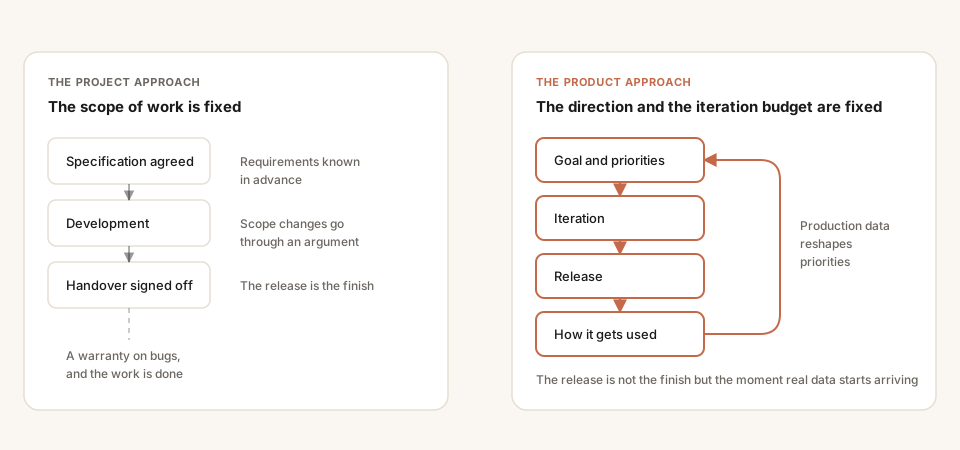
The difference is not code quality but where the contractor’s responsibility ends: at the acceptance certificate, or at a working process.
Five practical differences
The contract. Project: a fixed scope with the specification attached. Product: a framework agreement with iterations and a clear procedure for changing priorities. The second frightens clients with its openness, but it reflects reality more honestly when requirements are refined as you go.
The budget. A project quote names the final figure immediately and builds the risk of uncertainty into it, usually 20–40% on top. A product quote names the cost of an iteration and a horizon: at this pace, in six months, you get roughly this. In total the product approach is more often cheaper, because you are not paying insurance against the unknown.
The client’s role. In a project it is enough to accept the work. In a product approach you need someone on the business side who answers questions weekly and makes decisions. If that person does not exist, the product approach does not work — and that is an honest reason to decline it.
The team. A project gets by with developers working to a specification. A product approach needs someone who asks the business questions and turns the answers into requirements. Without that role, iterations become a stream of random tweaks.
After release. A project ends with a warranty period for fixing bugs. A product approach moves into monthly support with development. This is not about locking you into a subscription: a system integrated with your accounting and used every day needs attention simply because the APIs, the laws and the processes around it keep changing.
How to tell you need the product approach
Several signs, none decisive on its own, but together they give a clear picture.
The task is stated as a goal rather than a solution: “cut the time to process an order”, not “build this form”. There is more than one type of user, and their interests differ. The system will be integrated with what already runs, which means specifics nobody remembered will surface. The business process being automated is itself changing during the project.
The opposite signs, where the project approach is the right one: the scope really is clear, there are few integrations, the system is standalone, and nobody plans to develop it after launch. Such tasks exist, and selling iterations for them would be pushing something unnecessary.
It is also worth working out whether custom development is needed at all: often the task is closed by configuring an existing product. That is covered in build versus buy with the 30% rule.
What to ask a contractor
Three questions whose answers reveal the approach better than any presentation.
“What happens if in month three we realise the process works differently from how we described it?” A project contractor will explain the change procedure. A product one will explain how that is built into the process from the start.
“Who on your side will learn our business, and how often will we meet?” If the answer is “send the specification and we will take it from there”, it is a project scheme regardless of the label.
“What happens after launch?” The answer “a three-month bug warranty” and the answer “we move to monthly support with a development plan” describe two different products.
In short
Product-led custom development is not a trendier version of project work but a different way of distributing responsibility and risk. It fits when the task is more complex than its first formulation and the system will live and change. It does not fit when the scope is clear and there is nothing to develop.
The main practical criterion is having someone on the business side ready to take part weekly. With that person, the product approach gives a better result for the same money. Without them, it is better to take a fixed scope honestly and not pretend.
We work the second way: architecture and budget fixed at the start, then iterations with regular acceptance, and support after release. More on the custom B2B platform page and in the partner portal case, which grew exactly like this.
There is a third option that write-ups like this usually skip: if the same task repeats across dozens of organisations almost unchanged, there is no reason for each of them to pay for development. Then the right answer is not a project but a subscription to a finished product. We went down that road ourselves with a service for Orthodox parishes, where the scenario is identical for everyone and the differences come down to settings.
Facing a similar problem?
Tell us what you are building. We will walk through the architecture and give you a budget range in one call.